Birkly has one public templating language for site HTML. This page is the human SSOT pointer into that language. The engine source of truth is Birkly docs/TEMPLATE_LANGUAGE_SPEC.md (v1.0). Do not invent filters, Jinja syntax, or archived helpers.
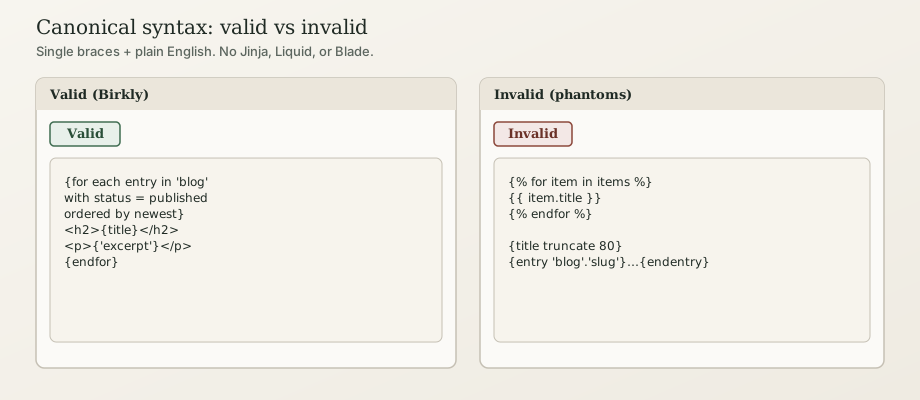
In short: Use single braces {…} and plain-English sentences. Loops: {for each entry in 'blog'}…{endfor}. Fields: {title} (system) and {'my_field'} (user). Public sites render with birkly-client.js. Admin UI uses a separate PHP parser — do not mix admin-only helpers into public HTML.
Beginner
Variables
{title}
{slug}
{'excerpt'}
{'price'}- System fields (every entry):
title,slug,id,status,created_at,updated_at, … — bare. - User-defined fields — always quoted:
{'content'},{'featured_image'}.
Loops (canonical)
{for each entry in 'blog' with status = published ordered by newest}
  <article>
    <h2><a href="post.html?collection=blog&slug={slug}">{title}</a></h2>
    <p>{'excerpt'}</p>
  </article>
{endfor}- Collection handle in single quotes.
- Close with
{endfor}. - Filters:
with …. Sort:ordered by …. Optional trailinglimit 5(space + number — notlimit=).
Single entry
{from 'site_elements' get entry 'header'}
  <header>{'content'}</header>
{endget}
Conditionals
{if 'site_elements'.'hero' exist}
  …
{endif}

{if entry has 'excerpt'}
  <p>{'excerpt'}</p>
{endif}
Forms (special)
Public contact-style forms use {entry for 'contact'}…{endentry} — that is a form scaffold, not the phantom single-entry block. See Public forms templating.
Phantoms — do not use
| Phantom | Use instead |
|---|---|
{{ title }} / {% for %} | {title} / {for each …} |
{entry 'blog'.'slug'}…{endentry} | {from 'blog' get entry 'slug'}…{endget} |
{ date "F j, Y" } | {created_at format "F j, Y"} |
{title truncate 80} | Dedicated excerpt field |
{'content' strip_tags} | Plain field or strip in CMS |
{from 'blog' get entries limit=5 sort="date:desc"} | {for each entry in 'blog' ordered by newest limit 5} |
{ media featured_image } | {'featured_image'} inside <img src="…"> (see Media in templates) |
ordered="date:desc" on regions | ordered="newest" / ordered="order" |
Advanced Users
For developers & AI
Engines (do not mix)
| Context | Engine | Location |
|---|---|---|
| Public site | Client / shared string engine | birkly-client.js, birkly-template-engine.js |
| Admin UI | PHP template parser | admin/template_parser.php |
| Legacy | Archived | Must not be documented as live |
Syntax rules aligned to TEMPLATE_LANGUAGE_SPEC
- Single braces only.
- Collections quoted; user fields quoted.
- Existence:
{if 'collection'.'entry' exist}. - Comparisons: prefer
=(also==);!=,<,>,<=,>=. - Ordering phrases:
newest,oldest,last-updated,order. - Date filter keyword is
formaton date fields. - Public API returns published entries for live loops.
Where the client renders
birkly-client.js scans Light DOM for outermost template-bearing elements, plus explicit data-birkly-region / <birkly-region>. Explicit children demote ancestors. Tags inside <script> / <style> or closed Shadow DOM are not discovered.
Admin-only helpers (never on public sites): {admin_url …}, {translate …}, {include_script …}, etc.
Validator: Birkly scripts/validate-project-templates.php flags phantom {entry 'x'.'y'} while allowing {entry for 'contact'}.